One of the most fascinating sights in nature is to see a massive school of fish maneuver en masse. Hundreds of minimally intelligent beings coordinating their actions in the blink of an eye (clicking that link on 18 Jan will lead to the wikipedia blackout site protesting SOPA, fyi), surrounding an object or projecting strength against an otherwise superior foe. The Genius of Swarms by National Geographic is a marvelous look at this phenomenon.
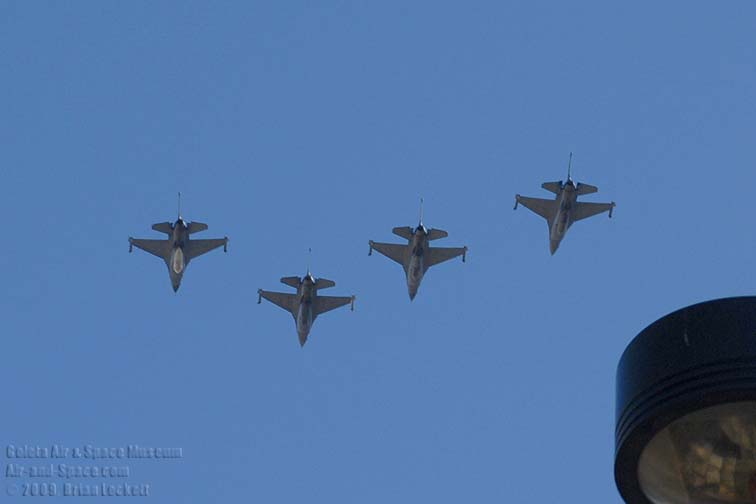
This is not a skill humans have yet mastered while in close proximity -- 9 out of 10 times during a four-plane flyover at a football game, its pretty easy to see which dude(tte) is out of position (especially if you're in the Air Force...).
As warfare has evolved, we've gone from the strategy of massed fighters to a more distributed and decentralized model. This allows for greater freedom of action, and more adaptable responses available to subordinate commanders. The evolution in warfare has also gone hand-in-hand with greater technological advancement, and the primacy of the individual unit.
The downside to this is cost -- namely that each fighting unit we purchase is better than the last, one v. one, but costs significantly more. So we buy fewer of them. For instance, during World War II, the US bought 16,500 P-51 Mustangs at an average unit cost of about $600,000 in today's dollars. We have recently purchased 187 F-22 Raptors at a cost of over $350 million per. Hypothetically, that money could have bought six F-16's. Is one F-22 worth more than six F-16's? Read on...
Ironically, the technology that allows for distributed tactics also necessarily implies a degree of consolidation as well -- we do more with less. Take an aircraft carrier. $6 billion to develop, it can carry an air wing of over 50 strike/fighter aircraft. Problem is, our adversaries know this as well, so they've endeavored to develop systems to overwhelm our defenses: anti-carrier ballistic missiles and more interestingly, swarms. Why take on the 50 when you can focus on the One?
Similarly, in the air, an F-22 is at least a generation in capabilities ahead of the venerable F-16. Yet, there being very few of them, they necessarily cover less ground than would a force that could blanket a battlespace. Sure, a Raptor could defeat a division of 4 top of the line Chinese fighters (assuming it had enough missiles...), but what if a foe sent 250 1960's era MiG-21's across the line at once from all different directions, impervious to losses? Could all of them be stopped? All it takes is one missile to get through, and there goes your carrier...
Warfare has a funny way of repeating itself. Perhaps Fifth Generation warfare will resemble First Generation massing more than Third Generation maneuver or Fourth Generation insurgencies. Or maybe it'll be a hybrid of swarming insurgencies maneuvering around nimble, but quantitatively inferior technologists.
This is not just a fantasy -- its been played out time and again in wargames. We just have a tendency to sweep it under the table when the results don't confirm our belief in the military-industrial technological marvels. I've written about this before -- see Millennium Challenge 2002 and Gladwell's How Underdogs Can Win (midpage). You've been given command of the bad guys in a training exercise? Throw as many cheap and independent units at the good guys as possible, and see how quickly they are overwhelmed.
As drone technology has grown, and as their numbers have as well, most of our strategists still use them as if they were manned fighters. Same tactics, same formations, same uses. We should be thinking completely outside the box with this new technology.
John Robb, one of the most brilliant military minds of our age, has talked extensively about this. Drone tactics go hand in hand with the growth in artificial intelligence. Computers inside small drones have the brain power of an insect -- and while this doesnt seem significant, when massed as insects do, this can cause real havoc. Would you rather be one human with a machine gun or a thousand angry bees?
But Robb goes farther and looks to one human controlling many drones. One of my favorite books, Ender's Game, has exactly that as its premise (with some other spectacular leadership and societal lessons thrown in as well). We're even "training" civilians to manage this -- video games like Starcraft are the perfect simulation for how the battles of the future may be fought.
So how do we counter this? Focus on decentralized, distributed solutions. Create our own swarms. Study and understand the phenomena. Build a couple hundred, few million dollar assets instead of only a few, billion dollar ones. Utilize technology, but don't limit it to existing orthodoxies. Create ad hoc innovation cells to determine unique solutions.
Technology is a great tool, but human ingenuity matters more. "Machines don't fight wars, men do -- and they use their minds." We're seeing that in response to pervasive technology, quantity when massed can have a quality all of its own.
This is not a skill humans have yet mastered while in close proximity -- 9 out of 10 times during a four-plane flyover at a football game, its pretty easy to see which dude(tte) is out of position (especially if you're in the Air Force...).
As warfare has evolved, we've gone from the strategy of massed fighters to a more distributed and decentralized model. This allows for greater freedom of action, and more adaptable responses available to subordinate commanders. The evolution in warfare has also gone hand-in-hand with greater technological advancement, and the primacy of the individual unit.
 |
| Something Seems Wrong with this Picture |
Ironically, the technology that allows for distributed tactics also necessarily implies a degree of consolidation as well -- we do more with less. Take an aircraft carrier. $6 billion to develop, it can carry an air wing of over 50 strike/fighter aircraft. Problem is, our adversaries know this as well, so they've endeavored to develop systems to overwhelm our defenses: anti-carrier ballistic missiles and more interestingly, swarms. Why take on the 50 when you can focus on the One?
Similarly, in the air, an F-22 is at least a generation in capabilities ahead of the venerable F-16. Yet, there being very few of them, they necessarily cover less ground than would a force that could blanket a battlespace. Sure, a Raptor could defeat a division of 4 top of the line Chinese fighters (assuming it had enough missiles...), but what if a foe sent 250 1960's era MiG-21's across the line at once from all different directions, impervious to losses? Could all of them be stopped? All it takes is one missile to get through, and there goes your carrier...
Warfare has a funny way of repeating itself. Perhaps Fifth Generation warfare will resemble First Generation massing more than Third Generation maneuver or Fourth Generation insurgencies. Or maybe it'll be a hybrid of swarming insurgencies maneuvering around nimble, but quantitatively inferior technologists.
This is not just a fantasy -- its been played out time and again in wargames. We just have a tendency to sweep it under the table when the results don't confirm our belief in the military-industrial technological marvels. I've written about this before -- see Millennium Challenge 2002 and Gladwell's How Underdogs Can Win (midpage). You've been given command of the bad guys in a training exercise? Throw as many cheap and independent units at the good guys as possible, and see how quickly they are overwhelmed.
As drone technology has grown, and as their numbers have as well, most of our strategists still use them as if they were manned fighters. Same tactics, same formations, same uses. We should be thinking completely outside the box with this new technology.
John Robb, one of the most brilliant military minds of our age, has talked extensively about this. Drone tactics go hand in hand with the growth in artificial intelligence. Computers inside small drones have the brain power of an insect -- and while this doesnt seem significant, when massed as insects do, this can cause real havoc. Would you rather be one human with a machine gun or a thousand angry bees?
 |
| This is Unexpected... |
So how do we counter this? Focus on decentralized, distributed solutions. Create our own swarms. Study and understand the phenomena. Build a couple hundred, few million dollar assets instead of only a few, billion dollar ones. Utilize technology, but don't limit it to existing orthodoxies. Create ad hoc innovation cells to determine unique solutions.
Technology is a great tool, but human ingenuity matters more. "Machines don't fight wars, men do -- and they use their minds." We're seeing that in response to pervasive technology, quantity when massed can have a quality all of its own.


 Posts
Posts