Showing posts with label Military. Show all posts

Wednesday, February 1, 2012

Junior Officers Take on the Establishment

Last Thursday, I had the chance, along with three other of my fellow military junior officers, to take part in a panel sponsored by the US Naval Institute and AFCEA.  It was in conjunction with the annual WEST 2012 Conference held at the San Diego Convention Center.

All of the members of the panel, including the moderator, Mr. Dan Moore, are members of Disruptive Thinkers.  Yes, it's not just a blog.  Disruptive Thinkers is a think tank we've started to bring military officers together with successful entrepreneurs in the hope that we can bring the best practices from each into our respective worlds.  Things like this panel are what our group is endeavoring to accomplish: Firm guidance from the innovation generation towards established interests that don't always know how (or want) to move forward.

The video is a bit long (1 hour, 7 minutes), but should give you an idea of the things on the minds of those fighting our nation's wars from the front lines.  The main themes? Place more trust in capable subordinate officers, and allow for a culture of innovation.  The last post on this site showed how the SEALs have done so very well.  We need every branch to emulate it. 

Monday, January 30, 2012

How the Navy SEALs Fight Smarter, Not Harder


Many Think Disruptively.  The following is the first in an ongoing series featuring guest bloggers with personal perspectives on things upending the status quo.  

This essay was written by someone who works closely with military special forces. John Boyd had it right when he said "Men, not machines, win wars.  And they use their minds."  The SEALs do this better than anybody.  Enjoy.

-------

If you are Jessica Buchanan or her family, it has been one damn good week. And for the public face of the US Navy SEALs, another significant, well-executed operation is added to a string of impressive successes. 

The Face of Innovation
The capabilities and combat precision of the SEALs is increasingly on display in print media, books, and soon, a major motion picture.  For the men within the SEAL community, however, this publicity is antithetical to their culture.  The mantra of “quiet professionalism” serves as a guiding principle from day one in the quest to become one of the world’s most elite warriors. 

That said, it bears looking into what is behind these triumphs.  Without a doubt, the special operations world is comprised of the most capable, intelligent warriors in contemporary history.  But why over the past decade have the SEALs experienced such noteworthy accomplishments, even when compared with other services Special Operations forces?

This question is especially important since the wars in Iraq and Afghanistan have been primarily land-based, and as of late, often fought in the mountains. While SEAL stands for SEa, Air, and Land, these operators are traditionally associated with maritime engagements.  So how does a seagoing force gain such pronounced land-based prominence?

To those who know these units and their impressive sub-cultures, the most significant aspect to the SEAL community is their unique culture of innovation.  Indeed, SEALs model many of the themes that dominate modern theories of innovation:
  • Lean: Even compared with other special operations forces, SEAL units maintain a small number of operators.
  • De-centralized: While the military hierarchy remains the central tenant of running any SEAL unit, there is an implicit element of autonomy expected of all special operators.
  • Agile: Even SEAL Teams have bureaucratic elements required to exist within the national security establishment. Yet the small, lean, and decentralized nature of the SEALs enable an ability to adapt and reposition themselves seamlessly as conflicts evolve.
These elements exist throughout all branches of special operations forces, but the aggressive training and constant desire for improvement speak loudest from Naval Special Warfare. 

A much more exclusive ingredient in the DNA of SEALs is that innovation and creativity are carefully ingrained in these men throughout their careers. It’s an axiom clearly articulated in the US Navy SEAL Ethos. And while the Ethos is worth the read for every American, here are three particularly insightful paragraphs:

We expect to lead and be led. In the absence of orders I will take charge, lead my teammates and accomplish the mission. I lead by example in all situations.

I will never quit. I persevere and thrive on adversity. My Nation expects me to be physically harder and mentally stronger than my enemies. If knocked down, I will get back up, every time.  I will draw on every remaining ounce of strength to protect my teammates and to accomplish our mission. I am never out of the fight.

We demand discipline. We expect innovation. The lives of my teammates and the success of our mission depend on me - my technical skill, tactical proficiency, and attention to detail. My training is never complete.

The Only Easy Day Was Yesterday
For those who have served in the military or know its strict hierarchy, these statements are profound. Although they have been part of other units' success, they are the bedrock of SEAL operations. Every man, not just officers, is expected to be able to lead if necessary. Moreover, in understanding that failure is not an option—as learned through the rigors of 18 months of SEAL training—innovation is expected.

The above lifestyle, only shared among those men who live and work in “the brotherhood,” when combined with the organizational structure of the SEAL Teams, makes for an astoundingly innovative culture. Men are expected to be thoughtful and have the self-discipline to seek constant improvement.  Most importantly, they endeavor to harness those assets for new and better approaches to warfare.

SEAL operators are constantly questioning, constantly brainstorming, and always looking for ‘a better way.’

A SEAL acquaintance recently shared a telling anecdote. During a cold-weather training mission, his unit had inserted onto a beach through arctic waters. As they began ascending a nearby mountain, the snow conditions changed so dramatically that it made their intended route virtually impassable without snowshoes. As the unit stopped to work through their options, one man cut down pine branches, used some excess rope (550 cord), and built a pair of workable snowshoes.

This sparked an idea in a teammate, who built off this thought by using his swim fins.  Once required for the water insertion, they now served as a foundation for impromptu snowshoes. The makeshift device worked, and within 20 minutes, the entire unit was moving up the mountain using their swim fins as improvised snowshoes.

It Pays to be a Winner
Since the beginning of the conflict in Afghanistan, the SEAL Teams have mastered this adaptive capability. The wealth of knowledge that returns from battlefield ‘lessons learned’ is applied to new training methods, tactical specialization, and force structure. Again, every unit in the American military does this in some form, but the SEAL’s competitive advantage is that they can do it so quickly and effectively.

This trend and its surgical effectiveness are being noticed by US policymakers. As the Pentagon painfully works to eliminate $500 billion from its budget over the next 10 years, hard choices have to be made.  However, Defense Secretary Leon Panetta announced this week that while many major defense programs would either be trimmed or completely eliminated, US special operations forces will continue to see increased funding. 

This past week’s rescue again proves that the United States remains a nation committed to, and capable of, protecting its citizens in even the most unseemly of places. Yet behind the scenes, the more subtle lesson is the importance and value of a culture steeped in innovation. 

Warfare, and world history, has always been shaped by those who best understand how to exploit and create new innovations.  The SEALs success is a direct result of this, and by inherently embracing it, will continue to lead the way for others to emulate.

Saturday, January 21, 2012

Taking on the Military-Industrial-Congressional Complex

Albert Einstein once noted that insanity is doing the same thing over and over again expecting different results.  If this definition is in fact true, then count the procurement of military fighter aircraft as insane.

When I was a wide-eyed and optimistic college senior, my honors thesis compared the procurement process of the F-22 Raptor with the F-35 Joint Strike Fighter.  I was naive enough to believe the latter would be better conducted than the former.  My beliefs were rooted in nothing more than vague government studies littered with various "data" and Lockheed promises of keeping on schedule and timeline.

Looking through this paper is rather amusing in 2012, particularly the JSF timeline, as outlined by the Government Accountability Office in 2004:
2008: First Operational Aircraft Delivered to USAF and USMC
2010: Navy receives first delivery of aircraft carrier capable JSF's
As those of us in aviation know, these dates have come and past, and still there is no firm promise as to when our new planes will be delivered.  The best estimate is 2016 for the Navy and 2015 for the USAF.  The Marine Corps Short Take-Off, Vertical Lift (STOVL) version may never actually be procured.  Appallingly, the carrier version of the JSF suffers from a rather significant engineering oversight:  the thing can't actually land on an aircraft carrier.   And despite the Marine Corps touting the ability for the STOVL version to operate from austere locations, they ignore the fact that stealth material doesn't hold up well in sandstorms (or even rain for that matter). 

I'm too sexy for...actual combat.
The projected flyaway cost in 2001 for the JSF was $69 million per aircraft.  This number is now $133 million -- and if you include the research and development costs, $156 million.  A doubling in one decade.  Furthermore, in 2004, over 2,900 planes were to be purchased -- the number has now declined to just a tad over 2,400.

This pretty much mirrors the F-22 Raptor glideslope.  Initially conceived of in April 1991, the program called for 880 planes being built at a cost of $45 million each.  By the end of its production run in 2009, only 187 had actually been built, at a per unit cost of $411 million. And according to the acolytes of John Boyd (the father of modern fighter tactics and design), a platform that failed to meet its ambitious promise. 

Fighter procurement was nicely summed up by Norman Augustine, the former chairman of Martin Marietta when he outlined his 16th law:
In the year 2054, the entire defense budget will purchase just one aircraft. The aircraft will have to be shared by the Air Force and Navy three and a half days each per week, except for the leap year, when it will be made available to the Marine Corps for the extra day.
Hyperbole to be sure, but sadly, derived from the trendline in decreasing overall acquisition numbers and rapidly increasing per unit cost. 

It would be nice if these over-promised, under-delivered platforms were relegated to aviation.  Alas, ship building (Littoral Combat Ship), Army kit (Future Combat System [FCS] and Comanche Helicopter), and space programs have all far exceed initial Congressional authorization timelines and budgetary constraints.  In many of these cases, promised technological advances have rarely been achieved.

So what is driving our accelerating defense outlays, reduced inventory and poor procurement record?  Established defense firms with strong Congressional backers and a bureaucratic acquisition process that inhibits innovative upstarts from making their mark.

Part of this goes to overall strategic aims: Organizations tend to gravitate towards things they do well.  The US military does state vs state warfare, with a defined adversary, incredibly competently:  look at Desert One and the March to Baghdad in 2003.   So the services want to buy whiz-bang gizmos that enable us to preserve this advantage.

In doing so, however, we neglect the fact that our enemies have adapted to neutralizing our technological and strategic advantages.  All but two of our conflicts over the past 50 years (the aforementioned ones...) were very different:  Insurgencies and police actions against sometimes hard to define foes.  The tools required in this type of fighting are 180 out from the massive land and sea battles Generals and Admirals salivate over.  They are usually less expensive, more singularly focused and definitely not sexy. 

Ugly, but Useful
But they work.  The Mine Resistant, Ambush Protected (MRAP) vehicle was fielded in a matter of months at a cost of $500,000 per vehicle, to adapt to a foe that we hadn't anticipated: the Improvised Explosive Device (IED).  Initially, it was innovative young Marines and soldiers bolting steel plates to their Humvees.  Eventually, industry caught on and created a suitable product.  Contrast this with the FCS, which was initially conceived of in 2000 and projected to cost $340 billion.  It prevented no losses to IED's and was cancelled in 2009.

Similarly, private industry has come up with effective, inexpensive solutions for providing Close Air Support.  The US military currently deploys $60 million F-18s, F-15s and F-16s into the skies over Afghanistan at a cost well above $20,000 per flight hour.  A more capable CAS platform, the Brazilian Super Tucano, can carry nearly the same weapons load, provide more on station time (4+ hours vs. 1 hour), and can operate from rugged, short, dirt strips. It costs about $15 million fully loaded, but more significantly, costs only $1,000 per flight hour.  Permissive airspace is required, but since that is what we find in most counter-insurgency situations, it is a great solution.  The US military just bought some for the Afghan military -- but refuses to do the same for our own warfighters. 

The Future?
In a professional aside, many of my fighter aviation peers, knowing what CAS looks like from above, would prefer to fly a Super Tucano type aircraft in Afghanistan.  Many ground controllers would prefer to have the on station time and weapon variety afforded by the Super Tucano, but not provided by traditional fighters.  Unfortunately, most of the procurement officials are so far removed from the battlefield, they don't understand this.


These rapid, adaptable procurement decisions are more in line with the evolution that occurred during WWII.  The United States created one of the most successful fighters in warfare, the P-51, in four months.  When the JSF finally comes online (still projected, of course), it will have been 20+ years since its initial inception.

We have a bloated defense budget that has been given free reign to expand as much as "needed" over the past decade.  This inhibits discipline, and fosters complacency.  Only well established firms know how to navigate the procurement labyrinth, and are wedded to maintaining the status quo of billions in profit each year from antiquated strategic visions.  This is not sustainable, and should not be acceptable to the American electorate.

There is a tendency to dismiss as unpatriotic anybody who questions the need for unlimited military funding.  Indeed, many of the same people who decry throwing good money after bad in education turn a blind eye to the same in the defense budget.  This must end.

We should hold companies and Congressmen accountable for their budgetary blunders.  The F-22 may bring tens of thousands of jobs to Georgia, but it has done nothing in fighting the War on Terror. Defense procurement is not a jobs program -- and anybody who thinks it is needs to spend more time on actual battlefields.

There is small progress that has been made on this front.  The Chief of Naval Operations has instituted a speed-to-fleet program, but it only applies to small procurement decisions.  More must be done. 

Until our country takes a good, hard look at the pernicious relationships between members of Congress, established defense firms and what it is we want our country to do in the realm of military responsibilities, we can expect the unwarranted influence of the military-industrial complex to continue unabated.  We need technologically capable kit; but we must also have a procurement system that reacts to reality, not Goliath's fed by Uncle Sam.

Tuesday, January 17, 2012

Swarms: You Can Run, but You Can't Hide

One of the most fascinating sights in nature is to see a massive school of fish maneuver en masse. Hundreds of minimally intelligent beings coordinating their actions in the blink of an eye (clicking that link on 18 Jan will lead to the wikipedia blackout site protesting SOPA, fyi), surrounding an object or projecting strength against an otherwise superior foe.  The Genius of Swarms by National Geographic is a marvelous look at this phenomenon.

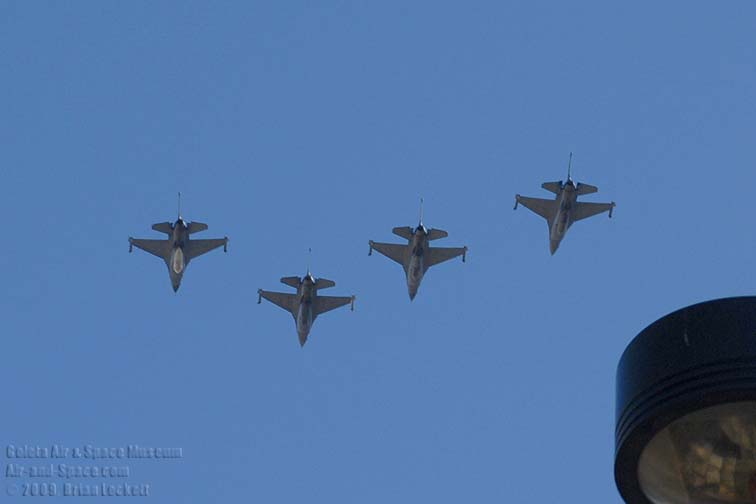
This is not a skill humans have yet mastered while in close proximity -- 9 out of 10 times during a four-plane flyover at a football game, its pretty easy to see which dude(tte) is out of position (especially if you're in the Air Force...)

As warfare has evolved, we've gone from the strategy of massed fighters to a more distributed and decentralized model.  This allows for greater freedom of action, and more adaptable responses available to subordinate commanders.  The evolution in warfare has also gone hand-in-hand with greater technological advancement, and the primacy of the individual unit.

Something Seems Wrong with this Picture
The downside to this is cost -- namely that each fighting unit we purchase is better than the last, one v. one, but costs significantly more.  So we buy fewer of them.  For instance, during World War II, the US bought 16,500 P-51 Mustangs at an average unit cost of about $600,000 in today's dollars.  We have recently purchased 187 F-22 Raptors at a cost of over $350 million per.  Hypothetically, that money could have bought six F-16's.  Is one F-22 worth more than six F-16's?  Read on...

Ironically, the technology that allows for distributed tactics also necessarily implies a degree of consolidation as well -- we do more with less.  Take an aircraft carrier.  $6 billion to develop, it can carry an air wing of over 50 strike/fighter aircraft.  Problem is, our adversaries know this as well, so they've endeavored to develop systems to overwhelm our defenses: anti-carrier ballistic missiles and more interestingly, swarms.  Why take on the 50 when you can focus on the One?

Similarly, in the air, an F-22 is at least a generation in capabilities ahead of the venerable F-16.  Yet, there being very few of them, they necessarily cover less ground than would a force that could blanket a battlespace.  Sure, a Raptor could defeat a division of 4 top of the line Chinese fighters (assuming it had enough missiles...), but what if a foe sent 250 1960's era MiG-21's across the line at once from all different directions, impervious to losses? Could all of them be stopped?  All it takes is one missile to get through, and there goes your carrier...

Warfare has a funny way of repeating itself.  Perhaps Fifth Generation warfare will resemble First Generation massing more than Third Generation maneuver or Fourth Generation insurgencies.  Or maybe it'll be a hybrid of swarming insurgencies maneuvering around nimble, but quantitatively inferior technologists.    

This is not just a fantasy -- its been played out time and again in wargames.  We just have a tendency to sweep it under the table when the results don't confirm our belief in the military-industrial technological marvels.  I've written about this before -- see Millennium Challenge 2002 and Gladwell's How Underdogs Can Win (midpage).  You've been given command of the bad guys in a training exercise?  Throw as many cheap and independent units at the good guys as possible, and see how quickly they are overwhelmed. 

As drone technology has grown, and as their numbers have as well, most of our strategists still use them as if they were manned fighters.  Same tactics, same formations, same uses.  We should be thinking completely outside the box with this new technology. 

John Robb, one of the most brilliant military minds of our age, has talked extensively about this.  Drone tactics go hand in hand with the growth in artificial intelligence.  Computers inside small drones have the brain power of an insect -- and while this doesnt seem significant, when massed as insects do, this can cause real havoc.  Would you rather be one human with a machine gun or a thousand angry bees?  

This is Unexpected...
But Robb goes farther and looks to one human controlling many drones.  One of my favorite books, Ender's Game, has exactly that as its premise (with some other spectacular leadership and societal lessons thrown in as well).  We're even "training" civilians to manage this -- video games like Starcraft are the perfect simulation for how the battles of the future may be fought.

So how do we counter this?  Focus on decentralized, distributed solutions.  Create our own swarms.  Study and understand the phenomena.  Build a couple hundred, few million dollar assets instead of only a few, billion dollar ones.  Utilize technology, but don't limit it to existing orthodoxies.  Create ad hoc innovation cells to determine unique solutions. 

Technology is a great tool, but human ingenuity matters more.  "Machines don't fight wars, men do -- and they use their minds."  We're seeing that in response to pervasive technology, quantity when massed can have a quality all of its own.